
Tidal Forces
Tidal forces are a fascinating phenomenon that arise from the gravitational interactions between celestial bodies. They play a crucial role in shaping not only the orbits of planets and moons but also their geological activity and surface features. Understanding tidal forces is essential for grasping how celestial mechanics operates on both small and large scales.
What Are Tidal Forces?
At its core, a tidal force occurs due to the differential gravitational pull exerted by one body (like the Moon) on different parts of another body (like Earth). This variation in gravity causes stretching and squishing effects, leading to observable phenomena such as tides in oceans.
Key Concepts:
- Gravitational Pull: The strength of gravity decreases with distance; hence, the side of an object closest to another mass experiences a stronger pull than the far side.
- Deformation: This difference creates bulges—one facing toward the other body and one facing away—which results in high tides at these locations while low tides occur perpendicular to them.
Practical Examples of Tidal Forces
- Ocean Tides on Earth:
- Earth’s oceans experience two high tides and two low tides approximately every 24 hours due to the Moon’s gravitational influence.
- When it’s full moon or new moon (spring tide), high tides are higher than usual because both Sun and Moon align, enhancing their combined gravitational effect.
- Conversely, during first quarter or last quarter phases (neap tide), there’s less pronounced tidal action since Sun’s pull counteracts some of Moon’s influence.
- Tidal Locking:
- A notable consequence of tidal forces is “tidal locking,” where a moon orbits its planet at such a rate that it always shows the same face towards it.
- For example, our Moon is tidally locked with Earth; this means we see only one hemisphere from our planet while its other half remains hidden from view.
- Geological Activity:
- Some celestial bodies exhibit significant geological activity due to strong tidal forces acting upon them.
- Jupiter’s moon Io is an excellent example; intense gravitational interactions with Jupiter cause Io’s interior to heat up through friction generated by constant deformation, resulting in numerous active volcanoes.
- Rings Around Planets:
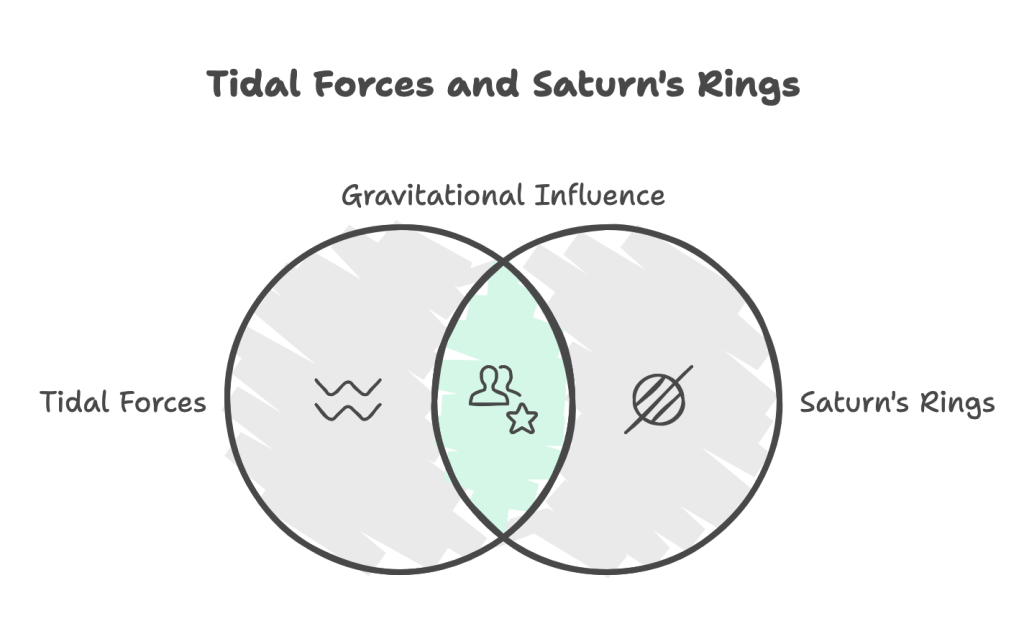
- The rings around Saturn are influenced by tidal forces as well. The planet’s strong gravity keeps particles within certain distances while preventing others from forming larger moons through disruptive tidal effects.
- Tides on Other Celestial Bodies:
- Mars has very weak oceanic tides compared to Earth because it has much less water coverage and weaker gravitational influences from its moons Phobos and Deimos.
- Impact on Orbital Dynamics:
- Over long periods, tidal forces can lead to changes in orbital dynamics like increasing orbital distance over time—as seen with Pluto which moves further away from Charon due to their mutual interaction via tidal mechanisms.
Conclusion
Understanding tidal forces provides insight into various astronomical phenomena—from simple oceanic patterns here on Earth to complex behaviors exhibited by distant moons and planets across our solar system—and reveals how interconnected celestial mechanics truly is! Recognizing these principles allows astronomers not just to predict movements but also appreciate how they shape worlds beyond our own through processes that have been ongoing for billions of years.